“My Baby Always Looks to One Side…”
You may have noticed:
- Your baby prefers looking one direction
- One shoulder seems elevated
- The head tilts consistently
- Feeding is easier on one side
- The head is flattening on one side
You were likely told:
“It’s just a tight muscle.”
While muscle tightness is part of torticollis, it’s rarely the full story.
Torticollis is often a sign of deeper nervous system and structural imbalance.
What Is Torticollis?
Torticollis (also called “wry neck”) is a condition where a baby’s head tilts to one side and rotates to the opposite side.
Most explanations focus on the sternocleidomastoid (SCM) muscle being tight.
But muscles don’t tighten randomly.
They tighten for a reason.
Why Muscles Tighten in Babies
Muscles are controlled by the nervous system.
If there is:
- Joint restriction
- Upper cervical tension
- Birth-related compression
- Nervous system stress
The body adapts.
One side tightens.
One side weakens.
The head tilts.
The muscle is responding — not malfunctioning.
The Birth Stress Connection
Birth is physically demanding on a baby’s head and neck.
Even in smooth deliveries, babies experience:
- Compression
- Twisting
- Traction forces
- Prolonged positioning
Higher-risk scenarios include:
- Long labor
- Fast labor
- Vacuum or forceps delivery
- C-section
- Large baby
- In-utero constraint
These forces can create upper cervical restriction and nervous system tension.
The body compensates through muscle guarding.
That guarding becomes torticollis.
Why Stretching Alone Isn’t Always Enough
Many families are referred to physical therapy.
Stretching can help lengthen tight muscles.
But if the underlying joint restriction or neurological imbalance remains, the tension often returns.
That’s why some parents say:
“We stretched constantly… but it keeps coming back.”
Because the root cause wasn’t fully addressed.
The Nervous System’s Role in Head Position
The upper cervical spine (top of the neck) is a critical neurological hub.
It influences:
- Muscle tone
- Vestibular function (balance)
- Eye tracking
- Feeding coordination
- Symmetry of movement
- Developmental milestones
When communication between the brain and body is altered, asymmetry develops.
Torticollis is often the first visible sign.
The Connection Between Torticollis & Plagiocephaly
When a baby consistently turns their head one direction:
- Pressure increases on one side of the skull
- Flattening (plagiocephaly) can develop
- Facial asymmetry may occur
The head shape change is secondary.
The underlying tension came first.
Addressing only the flat spot without addressing nervous system imbalance misses the root.
How Torticollis Impacts Development
If untreated, torticollis may affect:
- Rolling
- Crawling
- Midline crossing
- Eye tracking
- Feeding
- Sitting balance
- Motor symmetry
Babies learn through symmetrical movement.
Asymmetry early on can create compensation patterns later.
The earlier it’s addressed, the easier it is to correct.
Signs Torticollis Is More Than Just Muscle Tightness
You may also notice:
- Latching difficulty
- Reflux
- Colic
- Preference for one breast
- One arm moving more than the other
- Delayed milestones
- Arching or stiffness
These signs often point toward nervous system stress.
How Nervous System–Based Chiropractic Care Helps
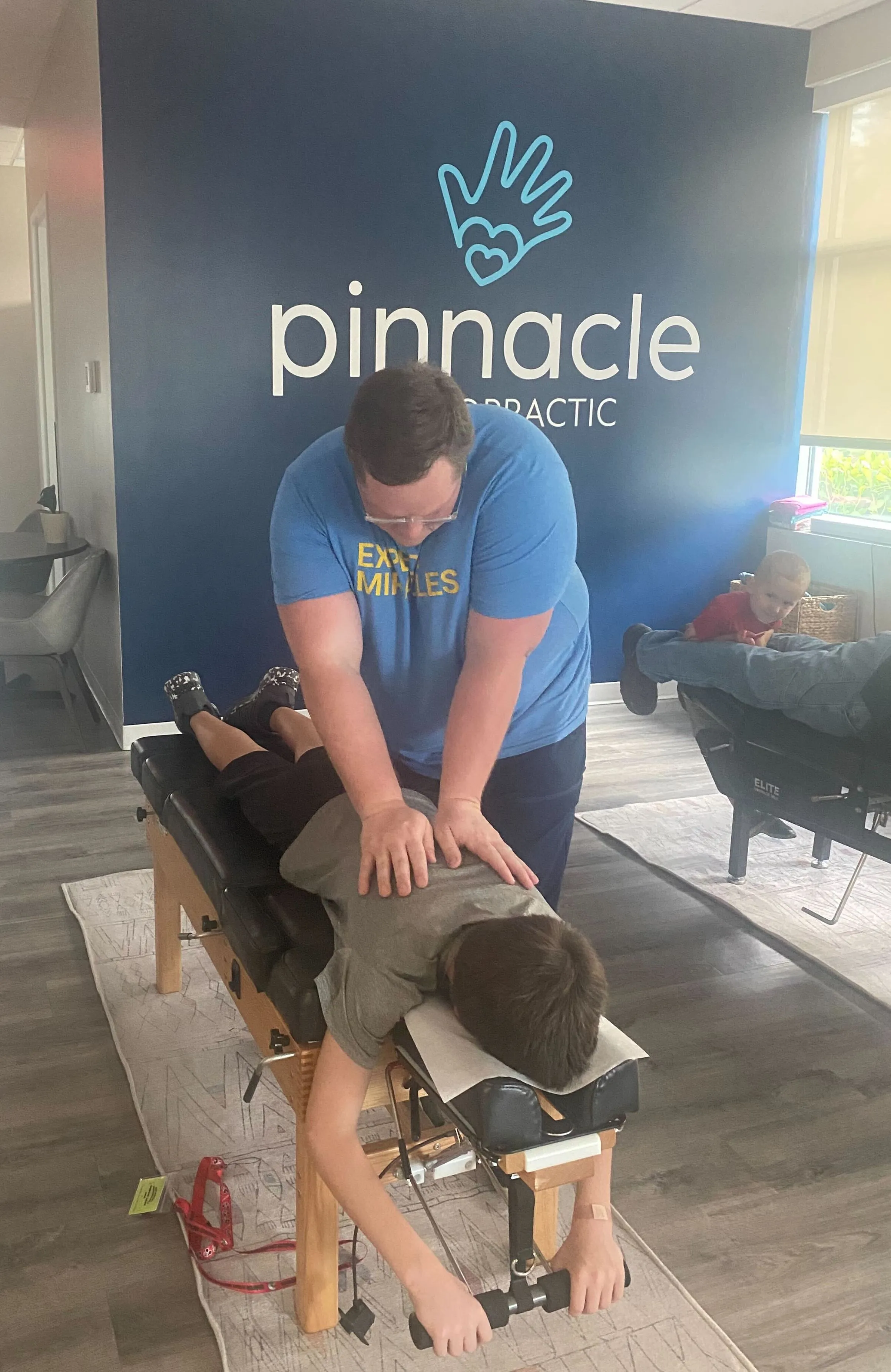
At Pinnacle Chiropractic, we evaluate babies with torticollis from a neurological perspective.
We use gentle, specific adjustments tailored to infants to:
- Reduce upper cervical tension
- Restore joint motion
- Improve brain-body communication
- Support symmetrical development
- Enhance parasympathetic regulation
Our doctors are extensively trained through the ICPA in pediatric and prenatal care.
Adjustments for babies are gentle — often using no more pressure than checking the ripeness of a tomato.
Parents frequently report:
- Improved head rotation
- Better feeding
- More symmetrical movement
- Reduced reflux
- Better sleep
Because when the nervous system regulates, the muscles follow.
Why Early Care Matters
Babies are incredibly adaptable.
The first year of life is when the nervous system is wiring at the fastest rate it ever will.
Addressing asymmetry early can:
- Prevent compensations
- Reduce need for helmet therapy
- Support milestone progression
- Improve feeding and sleep
- Strengthen long-term development
Waiting often makes correction harder.
Early support makes it easier.
Torticollis Is Communication
Your baby’s body is not broken.
It is adapting.
Torticollis isn’t just a tight neck.
It’s often a signal that the nervous system needs support.
When we address the root cause, development has room to flourish.
Why Families Trust Pinnacle Chiropractic
Pinnacle Chiropractic has been serving Bradenton, Sarasota, and Lakewood Ranch families for nearly a decade, specializing in neurologically focused pediatric and prenatal care.
Our mission:
Help every child reach their Pinnacle Potential.
📍 7984 Cooper Creek Blvd., Suite #104, University Park, FL 34201
📞 (941) 822-8828
Visit our website at https://www.pinnaclebradenton.com
Final Thoughts
If your baby prefers one side, tilts their head, or struggles with symmetry — don’t panic.
But don’t ignore it either.
Torticollis is common.
Chronic imbalance doesn’t have to be.
Early nervous system support can change the trajectory of development in powerful ways.



.webp)
.webp)